
Updates to the submission form and evaluation process aim to make project assessment more agile and transparent
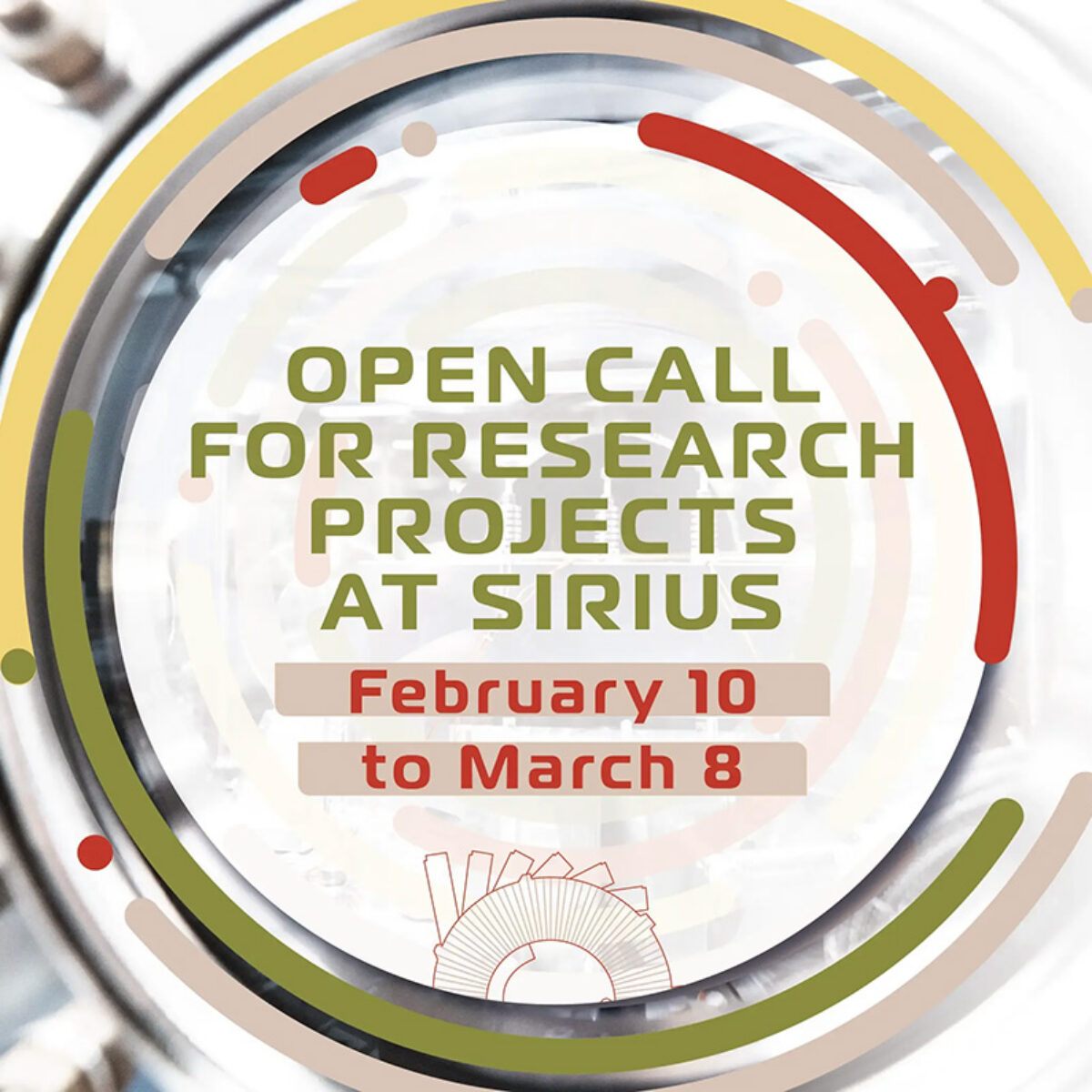
The Brazilian Center for Research in Energy and Materials (CNPEM), an organization supervised by the Ministry of Science, Technology and Innovation (MCTI), announces the opening of the seventh regular call for research proposals at Sirius, the fourth-generation synchrotron light source operated by the National Synchrotron Light Laboratory (LNLS).
Researchers interested in carrying out experiments at the ten Sirius beamlines available in this call may submit proposals from February 10 to March 8 through the SAU Online platform. The results of the call will be published on the CNPEM website in early June.
In addition to free access for academic purposes, researchers from Brazilian and international institutions based in Latin America and the Caribbean may apply for financial support covering meals, accommodation, and travel to Campinas, São Paulo, where the CNPEM campus is located.
In this call, the Sapucaia and Quati beamlines will be available for proposal submission for the first time. Both beamlines have undergone commissioning periods, including technical adjustments and testing of their installations, and are now joining the set of beamlines open to users.
SAPUCAIA (Scattering APparatUs for Complex Applications and In situ Assays) is dedicated to small-angle X-ray scattering (SAXS) and ultra-small-angle X-ray scattering (USAXS) techniques. These structural characterization methods are widely used to study morphological properties such as shape, size, distribution, and spatial organization of nano- and microstructured systems. In addition, these techniques enable time-resolved kinetic studies with temporal resolution on the order of milliseconds.
The beamline allows users to investigate relevant problems in the life sciences, with biological and medical applications, structural biology — including proteins, nucleic acids, lipids, and macromolecules in general — as well as multiple topics in materials science, such as nanotechnology, polymers, and environmental sciences.
The QUATI beamline (Quick X-ray Absorption Spectroscopy for Time- and Space-Resolved Experiments) is dedicated to X-ray absorption spectroscopy (XAS) experiments with high temporal and spatial resolution. The station provides XANES and EXAFS measurements in the 4.5–35 keV energy range, covering K-edges from titanium to xenon, as well as elements with L-edges.
With a variable beam size, Quati enables structural studies under in situ/operando conditions, including high temperatures, gas flow, or pressure, supporting applications in catalysis, materials science, nanotechnology, environmental sciences, and life sciences.
Starting with this call, the proposal submission form has been updated to make the scientific evaluation process clearer and more efficient, while also optimizing the use of the beamlines. The changes encourage more concise and objective texts, with well-defined hypotheses and consistent descriptions of the proposed experiment.
The new model emphasizes clarity, adherence to the scientific method, and detailed descriptions of prior characterizations supporting the feasibility of the study. The goal is to facilitate the identification of the study’s central idea and the maturity level of the proposed experiment.
“These updates are part of a continuous improvement process built through dialogue with the Sirius user community. The objective is to make submission and evaluation clearer and more efficient, valuing more objective and well-founded proposals and contributing to better use of the beamlines,” says LNLS Director Harry Westfahl Jr.
With these changes, LNLS aims to make the evaluation process more agile, transparent, and aligned with best practices, reducing ambiguities and increasing the overall quality of submitted proposals.
In addition to changes to the proposal format, the technical feasibility evaluation process will also be modified, becoming more active, continuous, and integrated into the submission workflow.
The analysis will begin as soon as a proposal is submitted, without the need to wait until the final deadline of the call (March 8). Beamline scientists will provide feedback as soon as possible, allowing proponents to clarify experimental aspects and, when feasible, adjust the proposal to the beamline’s capabilities.
After March 8, the system will remain open only for technical adjustments requested during the feasibility evaluation stage conducted by the beamline coordinators. Evaluations will take place until March 22, and early submission offers additional time for revisions and potential technical adjustments.
Ten beamlines are enabled to receive research proposals in this call. The Manacá and Cedro beamlines continue to receive proposals on a continuous basis through the Fast Track modality, meaning these beamlines remain open for proposal submission without interruption.
The beamlines receiving proposals in this cycle are:
Carnaúba: Micro- and nano-scale X-ray fluorescence, X-ray spectroscopy, and ptychographic imaging
Cateretê: Coherent diffraction imaging (ptychography) and X-ray photon correlation spectroscopy (XPCS)
Ema: X-ray diffraction and spectroscopy under extreme conditions of pressure, temperature, and magnetic field
Imbuia: Infrared nanospectroscopy (nano-FTIR)
Mogno: Micro- and nano-scale X-ray tomography
Paineira: Powder X-ray diffraction (PXRD)
Cedro: Electronic circular dichroism (CD) spectroscopy in the ultraviolet (UV) region
Manacá: Macromolecular microcrystallography (MX)
Sapucaia: Small-angle X-ray scattering (SAXS) and ultra-small-angle X-ray scattering (USAXS)
Quati: X-ray absorption spectroscopy (XAS) with high temporal and spatial resolution
During this call, the Ipê beamline will undergo an upgrade with the installation of a new undulator, expected to increase the photon flux by approximately one order of magnitude and enable vertical and circular polarization. These improvements will allow RIXS experiments to be carried out with higher resolution and under new experimental conditions. After installation, the beamline will go through a commissioning period and is expected to be ready to receive proposals in early 2027.
The Sabiá beamline will be dedicated to previously scheduled experiments and is expected to open for new proposal submissions in the next Sirius call.
Proposals will be evaluated through a distributed double-blind peer-review process, in which the Principal Investigators (PIs) submitting proposals also act as reviewers of other proposals from the community. Each submitted proposal is evaluated by at least five reviewers, and each PI is required to review five proposals, regardless of whether they are new submissions or resubmissions.
The quality of the reviews is taken into account in the final proposal score. Superficial or missing technical comments will result in penalties. Evaluation guidelines are available on the LNLS Users’ Page.
As in previous calls, well-evaluated proposals that were not awarded beamtime in the previous call may be resubmitted in this edition, with an automatic increase of 0.2 points added to the original score. To qualify, the proposal content must remain unchanged. If the proponent wishes to update the text, a new standard submission is required.
The resubmission functionality is available on the SAU Online platform. Resubmitted proposals also require the submission of five ad hoc reviews by the Principal Investigator (PI), as in standard submissions.
Although not yet included in this regular call, the Sapê and Tatu beamlines — dedicated to angle-resolved photoemission spectroscopy (ARPES) and terahertz nanospectroscopy, respectively — are currently in the commissioning phase. Experiments supporting the final adjustments of these stations are scheduled throughout 2026, with the participation of invited users. These beamlines will be available for regular submissions in future calls.
For more details on proposal submission and financial support, please consult the User Information page on the LNLS website. For questions, contact the User Office at edu@cnpem.br.
The Brazilian Center for Research in Energy and Materials (CNPEM) is home to a state-of-the-art, multi-user and multidisciplinary scientific environment and works on different fronts within the Brazilian National System for Science, Technology and Innovation. A social organization overseen by the Ministry of Science, Technology and Innovation (MCTI), CNPEM is driven by research that impacts the areas of health, energy, renewable materials, and sustainability. It is responsible for Sirius, the largest assembly of scientific equipment constructed in the country, and is currently constructing Project Orion, a laboratory complex for advanced pathogen research. Highly specialized science and engineering teams, sophisticated infrastructure open to the scientific community, strategic lines of investigation, innovative projects involving the productive sector, and training for researchers and students are the pillars of this institution that is unique in Brazil and able to serve as a bridge between knowledge and innovation. CNPEM’s research and development activities are carried out through its four National Laboratories: Synchrotron Light (LNLS), Biosciences (LNBio), Nanotechnology (LNNano), Biorenewables (LNBR), as well as its Technology Unit (DAT) and the Ilum School of Science — an undergraduate program in Science and Technology supported by the Ministry of Education (MEC).
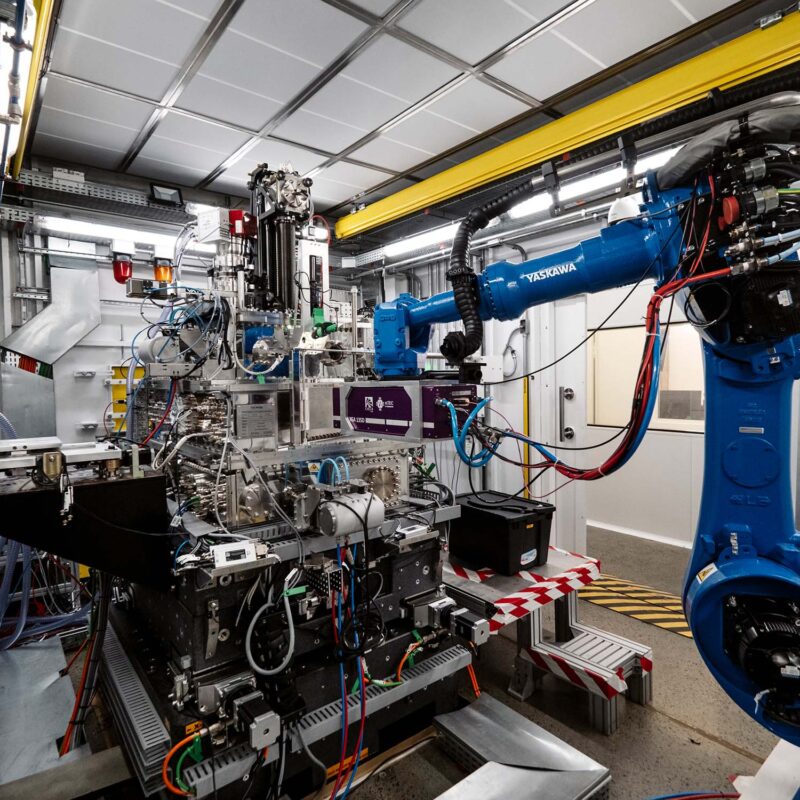
Designed to achieve resolutions on the order of 1 nanometer, the Sapoti station of the Carnaúba beamline combines cryogenics, ultra-high vacuum, and cutting-edge mechatronics engineering to reveal structures at the atomic scale

Infrastructure developed in partnership with Petrobras enables multiscale and automated tomographic imaging of carbonate samples