

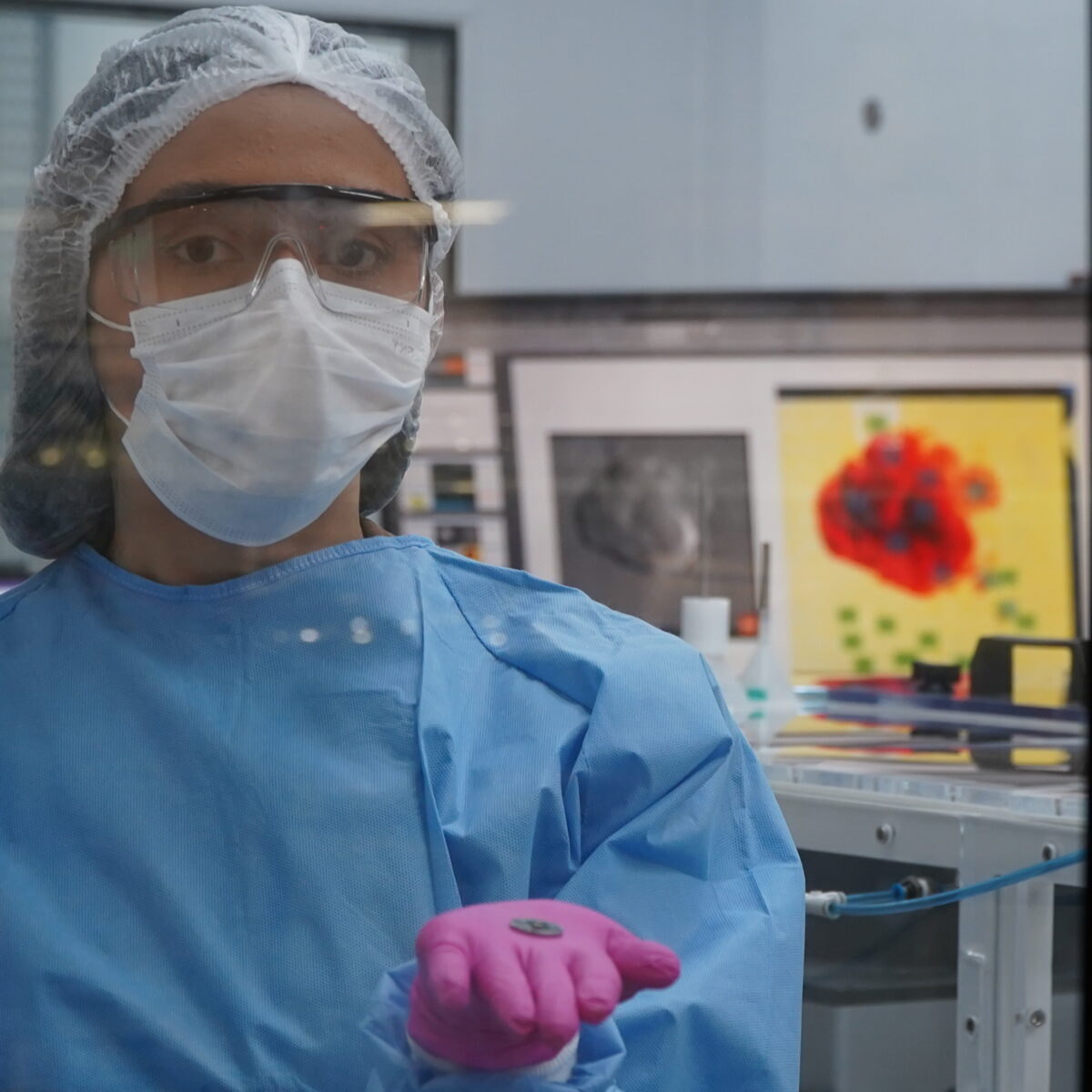
A researcher wearing personal protective equipment during an experiment conducted under Biosafety Level 2 (BSL-2) conditions at the Imbuia beamline at Sirius, investigating the interaction between nanomaterials and bacteria. (Image: CNPEM)
Article published in Photon Science details the reversible adaptation of laboratories and beamlines for Biosafety Level 2 (BSL-2) operations, enabling the analysis of samples under conditions closer to their natural state.
Researchers at the Brazilian Center for Research in Energy and Materials (CNPEM) have developed and validated an operational framework that allows Sirius beamlines and laboratories to be temporarily adapted for experiments involving biological samples that require Biosafety Level 2 (BSL-2) conditions.
The work, published in Photon Science, describes an approach combining physical containment, access control, user training, triple-containment sample transportation, beamline-specific procedures, and decontamination and restoration protocols. The framework has been implemented, validated, and institutionally approved at Sirius.
To prevent risks associated with handling certain materials, samples analyzed at synchrotron light sources are often fixed, sterilized, dehydrated, diluted, or subjected to other forms of preparation. Although these procedures facilitate experimental work, they can alter the structural, physicochemical, and dynamic properties of the samples. Working with less extensively modified materials makes it possible to investigate biological systems under conditions closer to their physiological state.
“The greatest challenge in conducting BSL-2 experiments at a beamline today is integrating biosafety requirements into a complex facility that houses highly sensitive equipment,” explains Ohanna Maria Menezes Madeiro da Costa, a researcher at the Imbuia beamline at Sirius and co-author of the article. “Without an appropriate biosafety environment, certain samples would need to undergo preparation procedures that could alter precisely the characteristics researchers want to investigate.”
The challenge is particularly complex at a synchrotron light source, where beamlines are multi-user facilities housing optical, electronic, cryogenic, and vacuum instruments that are sensitive to decontamination procedures. Therefore, rather than creating permanent containment environments, the work developed at Sirius establishes a reversible BSL-2 operational mode that allows facilities to be temporarily adapted for experimental campaigns and restored to their original operating conditions once the experiments are completed.
During the conversion process, the experimental area is reorganized into transition and working areas, including a restricted-access area with controlled movement of personnel and materials. Users undergo specific training, and operations can only begin after a biosafety inspection.
Sample handling is restricted to trained personnel, while data acquisition can be performed remotely from the control rooms. At the end of each experimental campaign, surfaces and equipment are decontaminated, waste is treated according to biosafety protocols, and a new inspection authorizes the return to conventional operations.
Currently, the Cateretê, Imbuia, and Cedro beamlines, as well as the Cryogenic Preparation Laboratory (LCRIO), are authorized to operate under these conditions.
The facilities already support studies involving different types of biological samples, including human serum and plasma, whole blood, and tumor and brain tissues. Techniques employed include circular dichroism, X-ray photon correlation spectroscopy, and nanoscale infrared spectroscopy.
At the Cedro beamline, experiments using human plasma make it possible to investigate proteins found in biological fluids. At Cateretê, scattering experiments can be used to study the dynamics of red blood cell suspensions. At Imbuia, nanoscale infrared spectroscopy enables the investigation of the chemical composition of biological systems.
One example is the work of PhD student Clara Lana Bispo Fidelis, who investigates the interaction between nanoparticles and bacteria. “When we fix a cell, a bacterium, we create a bond in its cell wall, and all the chemical bonds are altered. So, since we want to see exactly what those chemical bonds are like, the results would be significantly affected.”
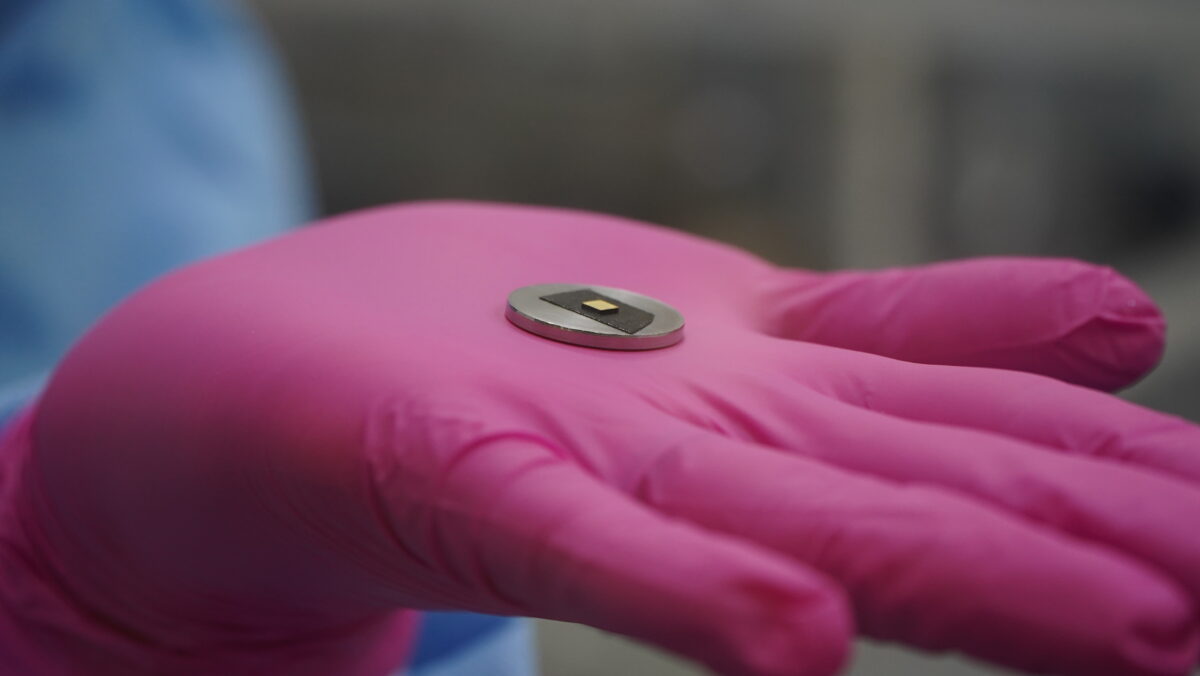
Sample used in an experiment at the Imbuia beamline at Sirius to investigate the interaction between nanomaterials and bacteria. (Image: CNPEM)
In her experiment at Imbuia, Clara investigates the interaction between bacteria and copper indium thiophosphate nanosheets. The technique provides nanoscale chemical information about this interface, helping researchers understand how the material interacts with bacteria.
The pioneering nature of the model developed at Sirius lies precisely in its ability to combine biosafety requirements with the flexibility needed in a multi-user research facility. “We are pioneers in doing this. There is no other place in the world where people are doing this. (…) It opens up a range of experimental possibilities for users that does not exist at any other synchrotron in the world,” says Mateus Borba Cardoso, head of the Soft and Biological Matter Division and co-author of the article.
By allowing research projects with and without biosafety requirements to alternate, the model expands the range of applications supported by the facility. “Today I can accommodate a BSL-2 proposal, and next week I can accommodate a research group that does not need this biosafety environment,” explains Ohanna.
The Brazilian Center for Research in Energy and Materials (CNPEM) is home to a state-of-the-art, multi-user and multidisciplinary scientific environment and works on different fronts within the Brazilian National System for Science, Technology and Innovation. A social organization overseen by the Ministry of Science, Technology and Innovation (MCTI), with the involvement of the Ministry of Education and the Ministry of Health, CNPEM is driven by research that impacts the areas of health, energy, renewable materials, and sustainability. It is responsible for Sirius, the largest assembly of scientific equipment constructed in the country, and is currently constructing Project Orion, a laboratory complex for advanced pathogen research. Highly specialized science and engineering teams, sophisticated infrastructure open to the scientific community, strategic lines of investigation, innovative projects involving the productive sector, and training for researchers and students are the pillars of this institution that is unique in Brazil and able to serve as a bridge between knowledge and innovation. CNPEM's research and development activities are carried out through its four National Laboratories: Synchrotron Light (LNLS), Biosciences (LNBio), Nanotechnology (LNNano), Biorenewables (LNBR), as well as its Technology Unit (DAT) and the Ilum School of Science — an undergraduate program in Science and Technology.
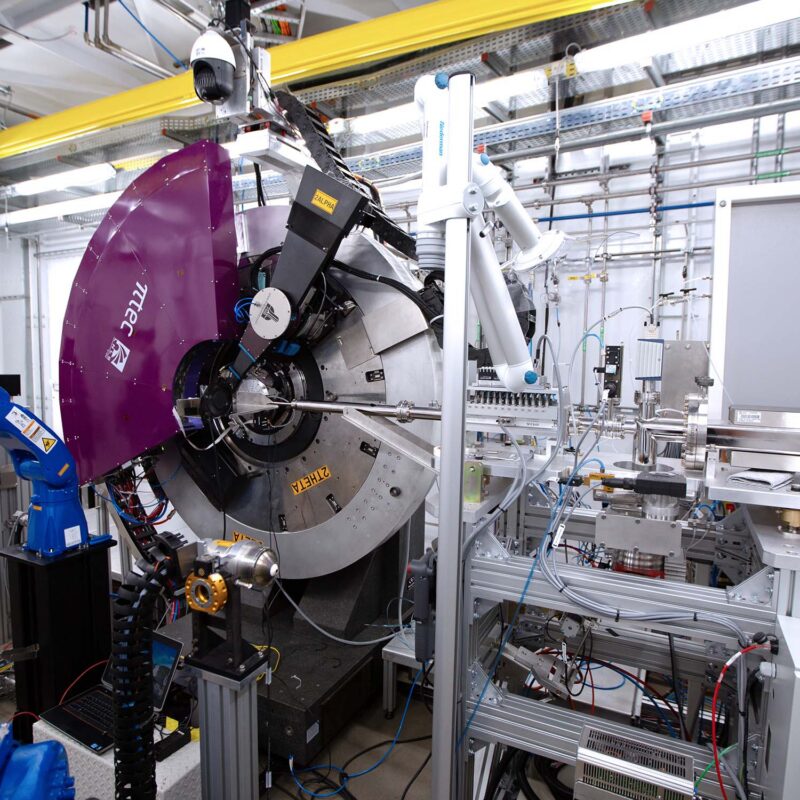
New operational mode enables users to send powder samples for automated X-ray diffraction measurements of polycrystalline materials, expanding access to the beamline without the need to travel to CNPEM
Proposal submission will be open from August 25 to September 15, 2026. Researchers may be contacted by beamline coordinators for clarification and potential adjustments to the submitted proposals until September 29, 2026.