

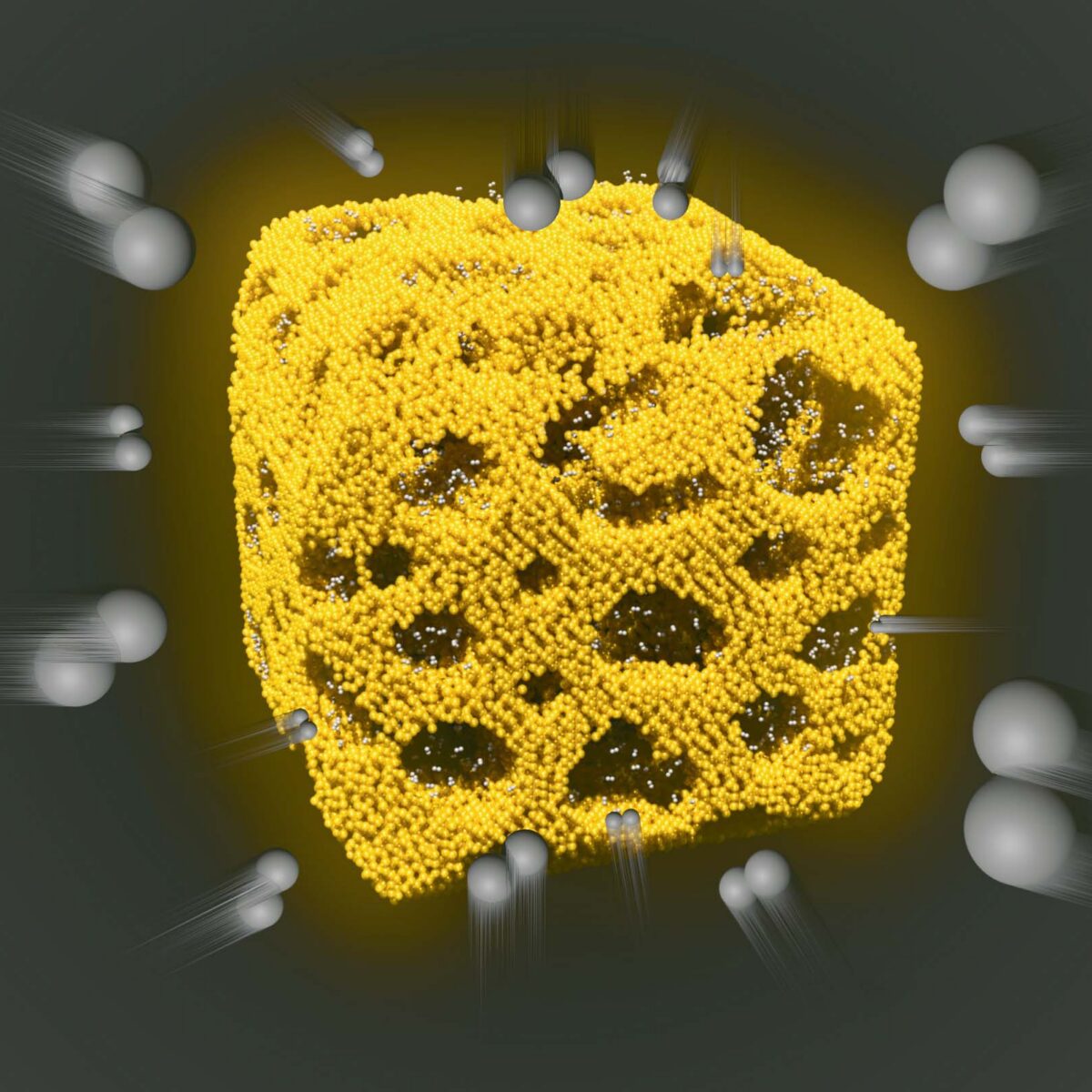
Metallic platinum and palladium nanofoams for hydrogen storage were investigated at the Carnaúba beamline of Sirius. (Journal of Materials Chemistry A, 2026).
Experiments at the Carnaúba beamline of Sirius have allowed researchers to identify where hydrogen accumulates in platinum and palladium structures
A study conducted by researchers from the Federal University of Rio Grande do Sul (UFRGS) and featured on the back cover of the Journal of Materials Chemistry A investigated a possible solution for hydrogen storage based on porous metallic nanostructures, called nanofoams. Part of the analysis was performed at the Carnaúba beamline of Sirius, whose spatial resolution allowed for the distinction of different regions of the material at the nanoscale.
Hydrogen is often cited as one of the leading candidates to drive the transition to a cleaner energy matrix. It can be produced from renewable sources and, when used, does not release carbon directly. However, despite this potential, its widespread adoption still faces a major challenge, which involves storing it in an efficient, safe, and economically viable way.
The most commonly used methods at present, such as storage under high pressure or at cryogenic temperatures, have significant limitations, whether due to high energy costs or technical challenges involved. The primary challenge, therefore, is to find systems that can not only absorb significant amounts of hydrogen, but also release it under practical conditions, which requires fine control of the interactions between hydrogen and the material.
To face this challenge, researchers explored a class of materials known as metallic nanostructures, including platinum- and palladium-based systems. “Today there is a great effort to make hydrogen-based technologies viable, but storage is still one of the main obstacles. There are well-defined goals, such as those of the United States Department of Energy (DOE), and we are still a long way from achieving them”, explains physicist Fabiano Bernardi.
The strategy adopted by the group stemmed from an idea already known in the literature: combining different metals to improve the interaction with hydrogen. But instead of following the traditional configuration, the researchers reversed the material’s architecture. “We decided to put the platinum on the inside and the palladium on the outside. The idea was to increase the number of sites where hydrogen could be stored”, says Bernardi.
Furthermore, the group used a different structure: so-called nanofoams. Unlike nanoparticles, these structures have a three-dimensional porous network with a large surface area, which significantly expands the possibilities for interaction with hydrogen.
The results showed that hydrogen is stored primarily just below the platinum-palladium interface. “What we observed is that the hydrogen remains in the subsurface of the platinum. Palladium, within the studied timescale, does not store hydrogen, but rather helps it diffuse to that location”, explains the researcher.
This combination of factors resulted in superior performance compared to similar systems previously reported in the literature. Nevertheless, the researcher himself points out that the field is far from meeting the requirements needed for commercial applications. “We are still far from the established goals, but this is already the best result for this type of system. The most important thing here was understanding the mechanism”, he says.
To understand where the hydrogen was actually being stored, the researchers resorted to advanced characterization techniques, including experiments conducted at the Carnaúba beamline of Sirius, at CNPEM.
The challenge was to distinguish the role of each component of the material: the nanofoam and the nanoparticles that are also part of the sample. “Our question was: is hydrogen storage happening primarily in the nanofoam or in the nanoparticle?”, explains Bernardi.
At the Carnaúba beamline, which has an X-ray beam with nanometric dimensions, it was possible to map specific regions of the sample and perform independent measurements on each of them. First, researchers spatially identified where the nanofoams and nanoparticles were located; then, they applied the XANES technique to investigate the electronic structure of platinum in each region.
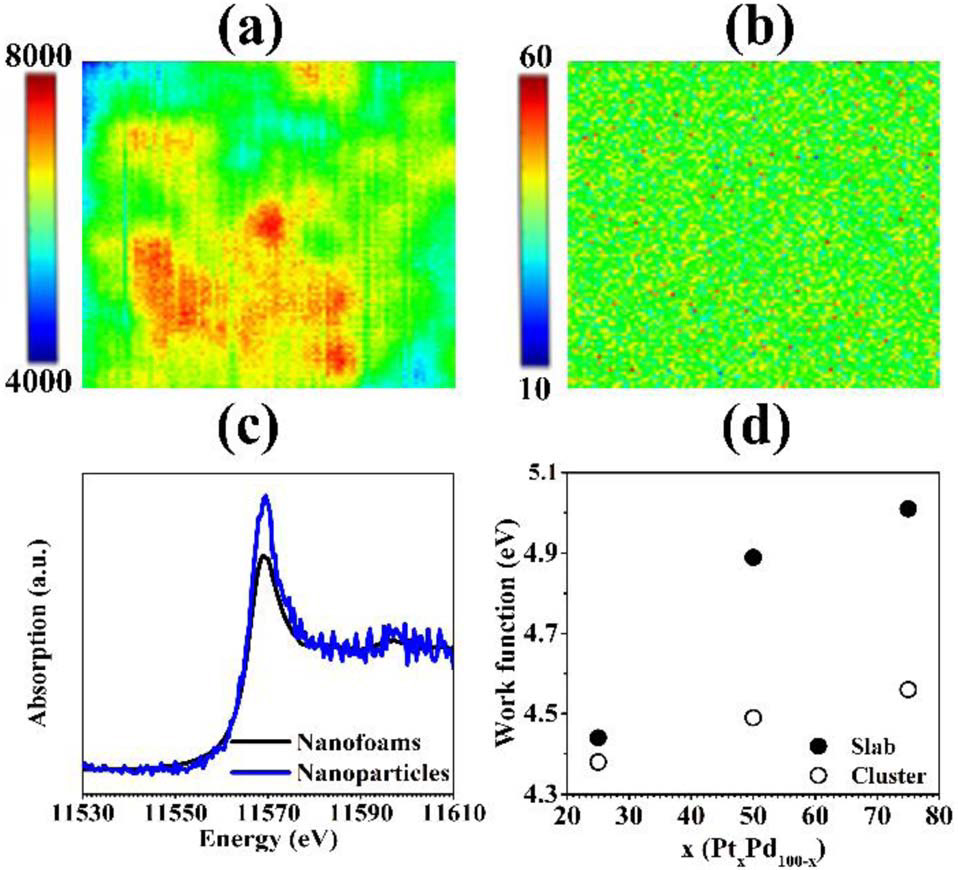
Fluorescence maps allowed researchers to distinguish regions of nanofoams and nanoparticles in the sample, where XANES measurements were performed on the L₃ edge of the platinum. Results indicate that the platinum in nanofoams is more metallic than in nanoparticles, a characteristic associated with a greater hydrogen storage capacity. (Journal of Materials Chemistry A, 2026). Available at: https://pubs.rsc.org/en/content/articlelanding/2026/ta/d5ta04270d
The results revealed a crucial difference: the platinum present in the nanofoams was in a more metallic state, while in the nanoparticles it appeared more oxidized. This distinction is crucial, since the metallic form interacts more strongly with hydrogen. “As it is well known that metallic platinum stores more hydrogen than platinum oxide, this shows that the process occurs mainly in the nanofoam”, states the researcher.
This ability to investigate specific regions of the material was essential to confirm the proposed mechanism and highlight the role of nanoarchitecture in the system’s performance. Without the spatial resolution provided by the Carnaúba beamline, this distinction would not be possible with the same clarity.
In the tests carried out, the best performance obtained was 0.58% by mass of stored hydrogen, a value still far from the targets set for practical applications, but which already represents a significant advance for systems of this type. This result was achieved under moderate atmospheric pressure and ambient temperature conditions, which leaves room for improvement. According to Bernardi, “if we reduce the temperature and increase the pressure within the limits considered viable by the DOE, this value should grow even more”.
For the next steps, the researchers intend to explore new combinations of bimetallic materials and different architectures, seeking to increase storage capacity and understand how to optimize this mechanism. “We continue investigating these systems, varying the metals and structure based on knowledge gained from work like this, to try to store more and more hydrogen”, says the researcher.
The Brazilian Center for Research in Energy and Materials (CNPEM) is home to a state-of-the-art, multi-user and multidisciplinary scientific environment and works on different fronts within the Brazilian National System for Science, Technology and Innovation. A social organization overseen by the Ministry of Science, Technology and Innovation (MCTI), CNPEM is driven by research that impacts the areas of health, energy, renewable materials, and sustainability. It is responsible for Sirius, the largest assembly of scientific equipment constructed in the country, and is currently constructing Project Orion, a laboratory complex for advanced pathogen research. Highly specialized science and engineering teams, sophisticated infrastructure open to the scientific community, strategic lines of investigation, innovative projects involving the productive sector, and training for researchers and students are the pillars of this institution that is unique in Brazil and able to serve as a bridge between knowledge and innovation. CNPEM’s research and development activities are carried out through its four National Laboratories: Synchrotron Light (LNLS), Biosciences (LNBio), Nanotechnology (LNNano), Biorenewables (LNBR), as well as its Technology Unit (DAT) and the Ilum School of Science — an undergraduate program in Science and Technology supported by the Ministry of Education (MEC).

Measurements obtained using several beamlines at Sirius provided strong evidence to classify fossil specimens of Spongiophyton nanum as a lichen, suggesting that these organisms strongly influenced the evolution of life in land environments
The study evaluated the use of CsPbBr3 crystals in hybrid detectors with integrated circuit developed at CERN