

The LNLS proposal evaluation process is based on a Distributed Double-Anonymization (DDA) system, consisting of peer review in which reviewers do not know the proposers and their institutes—and vice versa—and all proposers and principal investigators of proposals are potential reviewers. The evaluation process also includes proposals submitted by CNPEM researchers.
In addition to changes in the proposal format, the technical feasibility evaluation process will also be modified, becoming more active, continuous, and integrated into the submission and evaluation flow.
Technical feasibility analysis will begin at the moment of proposal submission, without the need to wait for the final call deadline. Beamline scientists will provide feedback on technical feasibility issues as quickly as possible, allowing proponents to clarify aspects of the experiment and, when feasible, adjust the proposal to suit beamline capabilities. This process creates a more dynamic interaction, enabling refinement of proposals to make them technically viable.
The proposal submission period runs from February 10 to March 8, 2026.
The interactive technical feasibility process, with the possibility of dialogue and adjustments, will occur from February 10 to March 22, 2026.
Between March 22 and 29, 2026, technical feasibility finalizations will be carried out, with no possibility of adjustments by proponents.
This new model aims to encourage proponents to submit their proposals before the final deadline (March 8, 2026), in order to allow more time for interaction with beamline teams and increase the chances that the proposed experiments are technically viable and well matched to Sirius infrastructure.
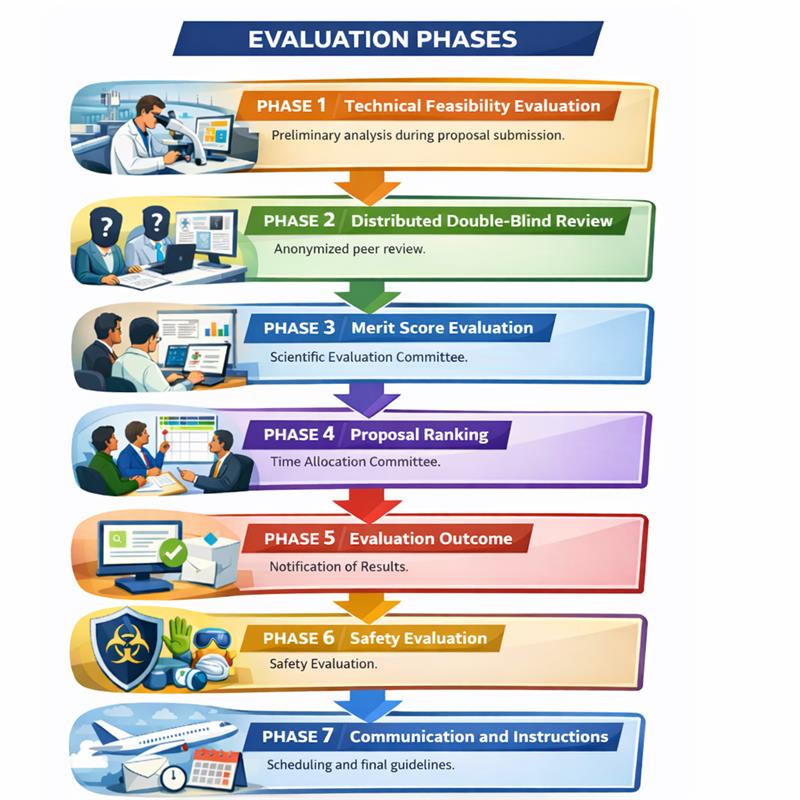
Phase 1 (Technical feasibility evaluation during the proposal submission period): Technical feasibility analysis will begin at the moment of proposal submission, without the need to wait for the final call deadline. Beamline scientists will provide feedback on technical feasibility issues as quickly as possible, allowing proponents to clarify aspects of the experiment and, when feasible, adjust the proposal to suit beamline capabilities. This process creates a more dynamic interaction, enabling refinement of proposals to make them technically viable.
Phase 2 (Distributed Double-Blind): Proposals previously anonymized on the SAU Online platform are distributed and evaluated by peers from the areas indicated when completing the submission form (area committee). The new-format evaluation seeks to prioritize clarity, objectivity, and adherence to the scientific method, allowing direct identification of: (i) the scientific hypotheses to be tested; (ii) whether the proposed experiment is suitable to test them; and (iii) the level of maturity of the study, based on prior characterizations already carried out.
Phase 3 (Merit score analysis): The Proposal Scientific Evaluation Committee (CACIP) analyzes and classifies competing proposals based on the scores received during Phase 2, may modify them, and prepares feedback texts to proponents. Particular attention is given to cases of major discrepancy between the received scores. CACIP will define the final score of proposals following the same criteria as Phase 1.
Phase 4 (Proposal ranking): Internal evaluation by the Beamline Time Allocation Committee, formed by LNLS management, which defines the final classification.
Phase 5 (Evaluation result): Proponents receive a notification through SAU Online informing them of the proposal evaluation result. However, the proposal will not yet be ready for scheduling execution dates, as sample safety evaluation will be required before advancing to the next stage.
Phase 6 (Safety): Internal evaluation by the Safety Committee of the highest-ranked proposals to ensure compliance with safety requirements. In case of doubts, the proponent receives a message from the SAU Online website and must provide all additional information promptly upon request.
Phase 7 (Communication and Instructions): Proponents receive a message from SAU Online with the scheduled period and instructions to prepare for arrival and execution of the proposal.
Reviewers are instructed to provide a detailed evaluation on the technical and scientific quality of the proposal, paying attention to the following items that will guide the report and the final grade:
Grades from 1 (lowest) to 5 (highest) will be assigned according to the guidelines below, and the overall grade will be the average between them.
Score and Criteria for evaluation of proposals:
Criterion 1 – Scientific Motivation, Goals, and Originality
5 – Extraordinary: Exceptionally clear motivation, well-defined goals, and highly original hypothesis.
4 – Excellent: Well-presented motivation, clear goals, and notable originality in the hypothesis.
3 – Good: Adequate motivation, defined goals, and reasonable hypothesis originality.
2 – Regular: Somewhat unclear motivation, imprecise goals, and limited hypothesis originality.
1 – Poor: Unclear/absent motivation, poorly defined goals, and minimal hypothesis originality.
Criterion 2 – Sample Description and Characterization
5 – Extraordinary: Extensively described samples with thorough previous characterization.
4 – Excellent: Well-described samples with solid previous characterization.
3 – Good: Adequate sample description with some previous characterization.
2 – Regular: Limited sample details and characterization.
1 – Poor: Unclear/insufficient sample information and characterization.
Criterion 3 – Synchrotron Justification
5 – Extraordinary: Comprehensive and compelling justification to the use of synchrotron radiation including very good preliminary studies and extraordinary alignment with the purpose of the applied facility.
4 – Excellent: Convincing justification to the use of synchrotron radiation with some preliminary studies and good match with the purpose of the applied facility.
3 – Good: Reasonable justification to the use of synchrotron radiation and reasonable match with the purpose of the applied facility.
2 – Regular: Limited justification to the use of synchrotron and not aligned with the purpose of the applied facility.
1 – Poor: Lack of justification to the use of synchrotron and the applied facility.
Criterion 4 – Expected Results and Experimental Technique
5 – Extraordinary: Exceptionally relevant results, meticulously chosen technique.
4 – Excellent: Highly relevant results, well-suited technique.
3 – Good: Scientifically and technically important results, appropriate technique.
2 – Regular: Limited relevance in results, questionable technique suitability.
1 – Poor: Insignificant results, inadequate or poorly chosen technique.
Weighted score ranking
A weighting value applied to a reviewer’s score based on their knowledge and expertise in the area of a proposal being evaluated aims to communicate the confidence of the reviewer in the grade assigned during the review process. Even if the reviewer is not an expert in the scientific area of the proposal, this weighting will be applied as a correction factor, and the value of the final grade will be adjusted by the CACIP committee accordingly.
A drop-down menu next to the grade to be assigned in the review screen of the proposal brings values of 0.5, 1.0 and 1.5, where the reviewer at the time of the evaluation will assign the weighting value. The CACIP will then jointly evaluate the grade assigned to the proposal and the weighting value to prepare the final grade and comments to users. The table below summarizes the attribution of the weight of the familiarity between the expertise area of the reviewer and the research area of the proposal to be evaluated.
| Weight | Knowledge in the research area |
| 0.5 | I do not have enough knowledge in the area |
| 1.0 | I have enough knowledge in the area to produce a qualified review. |
| 1.5 | I am a specialist working in the area and I can produce a well-qualified review. |
The Committee for the Scientific Evaluation of Proposals (CACIP), composed of renowned researchers external to CNPEM and experienced in synchrotron use, will analyze the scientific merit of research proposals based on anonymous reviewer reports. The final score of each proposal will be based exclusively on the distribution of reviewer evaluations and the information provided in the proposals.
The composition of the CACIP with their respective affiliations, areas of activity in the committee, and terms of office are provided in the table below. In case of unavailability of any member for any reason, LNLS will appoint a substitute. Terms of office may be renewed.
| Members | Filiation | Country | CACIP Area | Mandate |
|---|---|---|---|---|
| Marcelo Raul Ceolin | INIFTA | Argentina | Chemistry | 2022-24 |
| Maria Luiza Rocco | UFRJ | Brazil | Chemistry | 2022-24 |
| Watson Loh | UNICAMP | Brazil | Chemistry | 2022-24 |
| Alexandre Malta Rossi | CBPF | Brazil | Sustainability and Earth Sciences/Life Sciences | 2023-25 |
| Regina Cely Rodrigues Barroso | UERJ | Brazil | Sustainability and Earth Sciences/Life Sciences | 2022-24 |
| Teógenes Senna De Oliveira | UFV | Brazil | Sustainability and Earth Sciences/Life Sciences | 2022-24 |
| Wânia Duleba | USP | Brazil | Sustainability and Earth Sciences/Life Sciences | 2022-24 |
| Altair Soria Pereira | UFRGS | Brazil | Physics/Engineering | 2022-24 |
| Jonder Morais | UFRGS | Brazil | Physics/Engineering | 2022-24 |
| Paulo de Tarso | UFC | Brazil | Physics/Engineering | 2023-25 |
| Alejandro Pedro Ayala | UFC | Brazil | Physics/Engineering | 2024-26 |
| Abner de Siervo | UNICAMP | Brazil | Physics/Engineering | 2024-26 |
Criteria evaluated by the LNLS Allocation Committee (Stage 4 of the proposal flowchart):
Every proposal must be written in the third person so as not to intentionally identify the candidates. Below are some tips to help conceal the candidate’s identity and ensure a fairer proposal evaluation process:
Please contact the beamline teams and heads of LNLS scientific divisions to discuss your ideas (). For questions related to proposal submission guidelines, contact the User Office (EdU – edu@cnpem.br).